
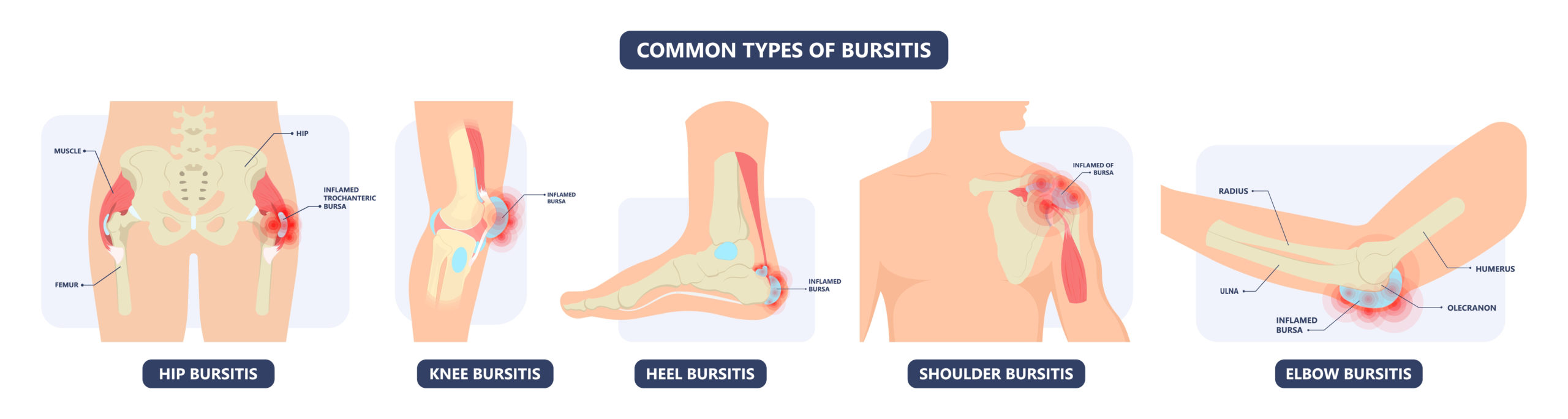
What is Bursae?
The bursae can be found on the shoulders, elbows, knees, femurs and other joints. The joint contains fluid which is used to reduce the friction caused by muscles, tendons, skin and bones during activities. For example, when the elbow is bent, stretched, and rotated, the bursae allows the skin to slide on the elbow.
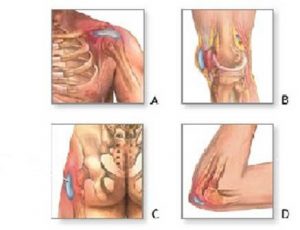
A. Shoulder B. Knee C. Femur D. Elbow
What causes Bursitis?
When the joint is injury or overworked, the bursae will produce a lot of fluid to protect the injured joint. As a result, excessive mucus can cause joint swelling and pain. If not handled properly, excess fluid can cause infection and inflammation.
The most common bursitis occurs in the knee, and patients often need to kneel on the ground for a long time to brush or clean the floor. Another common joint bursitis is the elbow, because of the long-term pressure on the elbow to work.
Symptoms of Bursitis
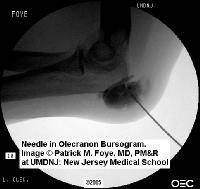
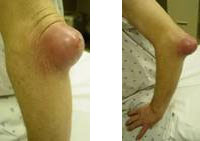
Patients will have swelling, pain, tenderness and redness in the joints of the patient, and limited joint movement. But the swelling is not in the joints, but in the bursae.
Treatment
- Try to rest the affected area
- Apply ice to the affected area 3 to 4 times a day, each time for about 20 to 30 minutes
- Ultrasound and low-energy laser can be used to reduce the symptoms of bursae inflammation
- Inflamed joints can be moved gently to avoid joint stiffness
- Can do some exercises to strengthen the joints and muscles of the affected area
- Symptoms can be improved after 7-14 days of treatment
If the condition does not improve or continues, the doctor will extract the patientu2019s mucus to reduce swelling. The extracted mucus may be tested for infection. If infection is found, antibiotics will be given.